
In Pakistan’s evolving fashion landscape, few stories are as compelling as that of Nauman Arfeen—a designer who transformed a traditional family craft into a full-fledged luxury fashion empire.
In this insightful interview with Haider Rifaat, Nauman Arfeen opens up about his journey from a pre-medical student to a leading name in groom wear, the philosophy behind his brand Naushemian, and the lessons he learned along the way.
This is not just an interview—it’s a masterclass in passion, persistence, and purpose.
📺 Watch the Full Interview
In this detailed conversation, Nauman Arfeen speaks with Haider Rifaat about his journey, philosophy, struggles, and milestones.
🗣️ Full Interview
Haider Rifaat: Nauman thank you so much for joining me for this interview
Nauman Arfeen: Thank you very much, Haider its always my pleasure to be here
Haider Rifaat: So Nauman, as I mentioned in your introduction, you’ve been part of this industry for 17 years. During my research, I found that you initially wanted to become a doctor—so what led you into fashion?
Nauman Arfeen: It’s a long story. I was initially a pre-medical student, but the family situation was quite different. I was the youngest in my family, and my two brothers were already doctors, so in a way, I became the “victim” of that expectation. My father noticed that I had a natural talent for turban wrapping, which was our family business. He asked me to continue the legacy, and that’s when I took over my father’s business, Hatvilla. However, turban wrapping alone was not my dream. Whenever I do something, I want to do it in the best possible way. That’s when I decided to start my brand Naushemian in 2002. At that time, there was no proper concept of art schools like today. I learned everything slowly and gradually—understanding, observing, and working on small details. Eventually, that journey brought me to where I am today. I formally stepped into fashion in 2009, and since then, my journey has continued.
Haider Rifaat: Did you actually study fashion?
Nauman Arfeen: No, I haven’t studied fashion—but I have taught fashion students many times. The reason is that when I entered this field, fashion schools were not very popular in Pakistan. Indus was there, but even there, fashion education wasn’t widely recognized in the late 90s. I completed my graduation and got into the family business, focusing more on turban wrapping at Hatvilla. Later, I became associated with an art school and continued working on both art and fashion. When I started the Naushemian brand, interns began joining to learn. I spent time teaching them art and fashion, and that’s how my journey in fashion evolved.
Haider Rifaat: I think turban-making was the turning point of your career in pursuing fashion.
Nauman Arfeen: Yes, absolutely. Turban wrapping is not easy—it’s an art. I have wrapped turbans in front of many people, but they still cannot do it themselves. It’s a cultural skill that I inherited and refined over time. I have wrapped thousands of turbans, and it was a very profitable business for us. At that time, designers used to take turbans from me and sell them with their sherwani packages. Gradually, I realized there was no concept of a place that offered complete groom services—turban, sherwani, and grooming—all in one place. That’s when I decided to start this business. Naushemian means groom. I created a brand where everything for a groom would be available under one roof. Today, this is common, but back in the late 90s and early 2000s, it was not. I gradually transitioned from turbans to sherwanis, and the journey kept progressing.
Haider Rifaat: So the philosophy behind Naushemian was to create a one-stop solution for grooms?
Nauman Arfeen: Absolutely. Initially, there were separate designers for turbans, footwear, and clothing—everyone had their own approach. But when you design everything together, you can create balance. For example, if the sherwani is loud, we keep the turban simple. If the sherwani is simple, we go for a more elaborate turban. This balance is very important. That was the core idea behind Naushemian—to provide everything under one roof.
Haider Rifaat: Right, right.
Nauman Arfeen: That was the whole idea.
Haider Rifaat: And Nauman, every designer has a design philosophy. What are your principles and codes as a designer?
Nauman Arfeen: My design philosophy is very simple: We take our heritage and present it with a modern appearance and silhouette. Today’s groom wants to carry culture, heritage, and elegance together. Just like brides traditionally wear red, grooms also have cultural expectations, such as wearing lighter-colored sherwanis. However, modern grooms want a contemporary impact. So my philosophy is to blend heritage with modern design and create something relevant for today’s era.
Haider Rifaat: You started your journey in 2002. Every industry has its challenges, especially one as competitive as fashion, so any initial setback and challenges that you experienced as a young Nauman Arfeen?
Nauman Arfeen: There were many challenges—falling, getting back up, and moving forward. It was a long journey. The reality is that at a young age, we make many mistakes, and we learn from them. girna uthna usky baad phir chalna so that was a long journey, asal mai problem ye hoti hy ky jo young age me hum ghaltiyaan bht krty hain aur ghaltiyo sy hum seekhty hain even in fashion weeks mery andr ek bht cheez hoti thi me na apny hi kaam sy satisfy nahi ho paata tha. Even during fashion weeks, I had this constant feeling of dissatisfaction with my own work. After every show, I would think, “Mai is sy acha kar skta hu.” Then I would do another show and feel the same again. That lack of satisfaction became a driving force. Even today, it’s very difficult for me to feel fully satisfied with my work. I always believe there is room for improvement. Mujhy ye pta hota hy ky is ky andr bht sari space hy me isko aur acha kr skta hu phir me achy sy achy ki talash me chlta rhta hu, ye meri journey hamesha chlti hi rehy gi aaj sy nahi zamaano sy and that’s make me a better person and a better designer
Haider Rifaat: Yeah, I think I remember someone saying—and I don’t know who it was—but someone said, “You’re only as good as your next collection.” So I think you learn from your mistakes and eventually improve.
Nauman Arfeen: Absolutely.
Haider Rifaat: I want to talk about turbans again. Specifically, what is the significance of turbans for you as a designer? Since you started with it, learned the craft, and that’s what initially brought you into fashion—what is the significance of turbans in Pakistan?
Nauman Arfeen: If you’ve heard of Aitchison College Lahore, turbans are mandatory in their assembly. And if a groom is getting married in Lahore, he is considered incomplete without wearing an Aitchison turban. For example, if you’ve seen Junaid Safdar, the son of Maryam Nawaz—he wore the Aitchison turban at both of his wedding events. That’s because in Lahore, it’s part of the culture that a groom is incomplete without it. In Pakistan, turbans have always been popular. In Karachi, especially in the 90s, the Aitchison style was very common—though now it’s not as dominant as before. Culturally, Indo-Pak traditions are deeply connected, as we were once one region before partition. In Karachi, many people migrated from India (Muhajireen), so there is a strong Indian influence. That’s why we see styles like Rajasthani and Jaipuri turbans as well. If we talk about significance, I would say a groom is incomplete without headgear. Earlier, people used to wear Jinnah caps or Liaquat caps. Covering the groom’s head at the nikkah ceremony has always been important. Over time, turbans replaced those caps and evolved into a fashion statement with multiple styles. Since I’ve been wrapping turbans for so long, I always wish this tradition never ends. That’s why I still do live turban wrapping in different styles—so people appreciate it and continue the trend. Even if someone gets their sherwani from somewhere else or through family, they still come to us specifically for the turban. That shows how significant it is!
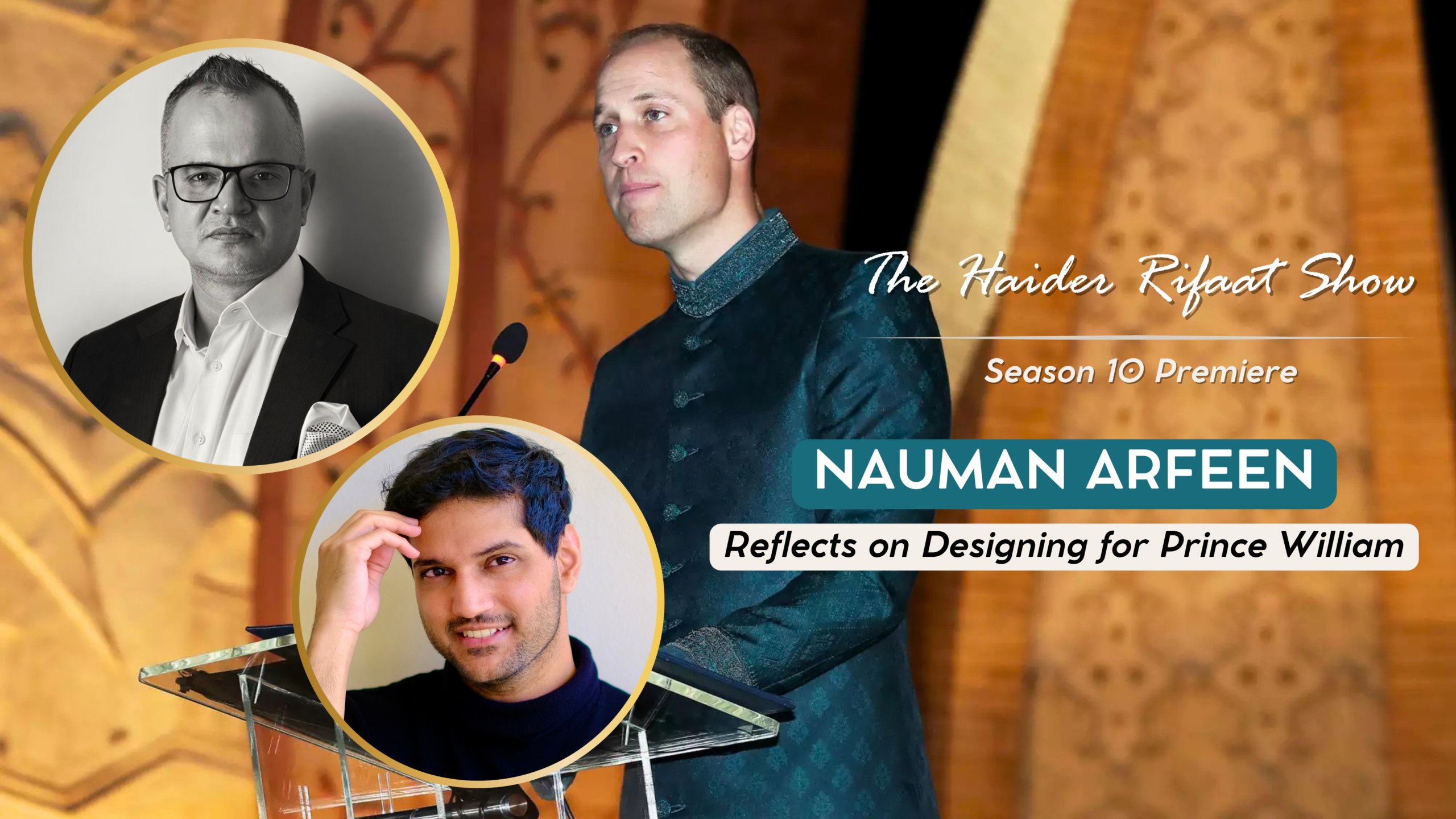
Haider Rifaat: True—there’s a lot of historical and cultural significance there. Thank you, that was a great learning point for me as well. I also wanted to ask about the teal sherwani you designed for Prince William when he visited Pakistan in 2019. I personally loved it—it created a lot of buzz. How did that opportunity come about?
Nauman Arfeen: That’s a very interesting story. I really admire royal families because they do extensive homework before making any decision. When their Pakistan visit was planned, their team visited places where my work was stocked in UK. They saw my sherwanis, explored the brand, and did complete research on my background. It wasn’t a simple process. They could have easily chosen an Indian designer as well, but they specifically wanted a Pakistani designer.
After their research, they contacted me and initially requested a blue sherwani. However, I suggested that instead of blue, he should wear teal green. Vo bht sari cheezy apni disclose nhi kr rhy thy aur me bhi ehtitat sy puch rhatha ky kahi unko kuch bura na lg jye. Eventually, I finalized the design in teal. They asked me to send both options—the one they ordered and the teal one—and said they would decide what suits Prince William best. In the end, they loved the teal sherwani I designed.
The most interesting part was that I only received one picture of him—and from that, I estimated his body measurements and created a perfectly fitted sherwani. That was a historical and memorable event for me jis tareeky vo bni thi bht maza aya tha unho ny bht izzat di mjhy aur khas tor py mjhy kaha ttha ky disclose nahi krna ky you are making this sherwani vo khud baad me disclose krna chahty thy. Many designers were claiming they had contributed, but I stayed quiet. lkn jb vo utry thy apny rickshaw sy the whole thing happened, pury social media py vo clip viral hony lg gya vo bht acha time tha! What stood out most was how gracefully he carried the outfit. Honestly, unho ny phna bht achy sy tha that was the main thing, jesy unho ny pehna tha shaid hamary Pakistani bhi itny pyar syn ahi pehenty jis trha pyar sy unho ny hamari sherwani pehni thi
Haider Rifaat: Yes, it was a very classy sherwani, and that color was stunning. Why didn’t you make him wear a turban?
Nauman Arfeen: Ha ha I would have loved to—but he didn’t want to wear a turban. He only wanted to wear a sherwani. Also, if he had worn a turban, it would have had to be an Aitchison style. And once you wear a turban, you look more like a groom.
Haider Rifaat: That is true.
Nauman Arfeen: Our sherwani has roots going back to Quaid-e-Azam and that cultural perspective he admired. Prince William appreciated that and wanted a modern interpretation of a traditional outfit—that’s why he chose not to wear a turban.
Haider Rifaat: Do you think that moment brought more international opportunities and collaborations for your brand?
Nauman Arfeen: Absolutely. I still remember—he visited in October 2019, and by December, COVID-19 started, and everything shut down. But before that, the exposure was massive worldwide. Our international e-commerce business began to grow significantly. People already knew me from my 15-year journey, but this moment gave us global visibility. People admired Prince William a lot—mjhy ye to pta tha ky prince ko log bht admire krty thy lkn ye andaza ni tha ky itna ziada pyar krty thy, to log humy khny lgy ky jesa unho ny phna hy humy wesi hi sherwani chaiay so that was the thing so bht haseen pal thy I wish mjhy wesi opportunity zindagi me dubara mily
Haider Rifaat: InshaAllah, I’m sure you will. With time, networking, and collaboration, opportunities always come. Let me ask you— ap ko lgta hy ky fashion industry has been a very cutthroat place for you as a designer kabhi feel hua ky competition bht hy, comparisons me log pr jaty hain, it’s not just about the fashion industry, ap kisi bhi field ko dekh len when you see someone a little bit more successful, you feel good for them, but at the same time you do some instrospection and start doubting yourself that am I doing the right thing pessimism bht hota hy how do u take that?
Nauman Arfeen: See Competition is very important. It’s like a current—without it, there’s no energy or motivation to work. Healthy competition is good. It all depends on how a designer handles it. For me, the focus is always on my brand: Strong identity, Quality clothing, Better cuts, Better craftsmanship, Better stitching! If I focus on these things, my brand will naturally grow stronger. If there’s no competition, there’s no excitement. Hum jab fashion week krty thy that was the time k jab hamary fpw2009 till 2019 tk ek era tha 10 years ka, tha tb hamara ek bht ziada rhta tha ky kis ki collection is saal best jyegi kon acha kaam kr rha hy to vo ek energy level boost rehti thi
As Allama Iqbal said:
“Lapatna, jhapakna, jhapak ke palatna — lahu garam rakhne ka hai ek bahana.”
That passion kept us going. I’ve always appreciated healthy competition.
Haider Rifaat: Nauman apni new collection ka btyen, what are you currently working on?
Nauman Arfeen: Right now, I’m working on two collections: One in pastel shades and One in darker tones. The essence of Naushemian is very traditional—we don’t create unnecessary drama. Today, the market has changed. Along with store business, our social media and e-commerce have grown significantly. People love cultural designs, but they also want a modern feel. My focus is always Smart look, Perfect fitting, High-quality stitching, Strong craftsmanship. The current collection includes heavy embroidery, sequins, and deep textures. Jesy meri aadat hogai hy ky mjhy plain cheezy pasand nhi ati asi ayi ky samny aaky feel huay that something is going on, jesy agar me kisi bary designer ky pas jata hu to unki quality ye hoti hy ky unki craftsmanship itni khoobsoorat hoti hy ky me kareeb sy ja ky dekhta hu ky isny kaam kesy kia hua hy, mery leay ye details important hoti hy. So Im currently working on 2 collections, one is Nayaab will be launched in mid of 2026, and second is Seyaah Noor collection which will focus on bold black on which im working and focusing currently, asi bnau ky log isko dekhen aur psnd kren
Haider Rifaat: Apka jo brand hy mostly it caters to men but I have scanned through your website, you have many women’s collections too. Tell a bit about that
Nauman Arfeen: Hr designer py ek Thapa ek stamp lg jata hy aur mery upar Prince Willaim ny asi stamp lga di hy that I am a sherwani maker. Prince William kind of gave me a “stamp” as a sherwani designer—and honestly, I’m proud of that! Aur mai itny saalo sy isme kaam kra hu to log mjhy sherwani designer, grrom wear designer, as a festive designer log mjhy ziada admire krty hain, log mjhy shaid fashion designer na bolty houn gy mjhy khty hain im a wedding designer, im a festive designer, I think the word festive is very important kiuki ab designers me bhi categories aany shuru hogai hain baat ye hy ky me women wear bhi krta hu, suiting bhi krta hu, pret bhi krta hu, lkn mery upar sherwani ki stamp lg gai hy. And that’s a good thing. Many designers wish for such a clear identity. So I feel happy ky mery upar vo stamp lg gya hy and im enjoying it maza arha hy mjhy
Haider Rifaat: What’s your take on fast fashion vs luxury fashion?
Nauman Arfeen: If I speak from a business perspective, people say: sell what everyone needs if you want to become very rich. Fast fashion sells more because it’s affordable. But I’ve now positioned myself as a luxury designer. And luxury and fast fashion are completely different. If I launch a pret line, it won’t be as strong as my luxury work—because every field requires specialization. Agar me sochu me koi pret line launch kru to me shaid pret line itni achi nahi launch kr skta jitni achi me luxury pret ko launch kr skta hu. Jis trha medicial field me hr cheez me specialization hoti hy wesy hi hamari field me hr cheez me specialization hy
Haider Rifaat: That’s very well said. Lastly, who do you credit for your success?
Nauman Arfeen: Honestly, my family. They supported me throughout my journey. The industry also supported me in many ways. Few people in the industry really pushed me to do certain things that gave me a direction. I am not going to take name of any person, kiuki ek ka naam lia to baaki naraz hojye gy lkn support kaafi ziada rha industry ki trf sy bhi aur family ki trf sy bhi. It hasn’t been easy— bht gira hu, bht smbhla hu, bht sary logo ny leg pulling bhi ki hy, like aaj me jis jga betha hu ye journey itni asan nahi thi lkn hr wkt hr jga lrty smbhalty krty karaaty yaha tk pohnch gye. If I have to give credit, it goes to my family. Their support and encouragement made me who I am today.
Haider Rifaat: That’s wonderful. Lastly, what advice would you give to young designers?
Nauman Arfeen: Logo ky peachy na bhaagy. A good designer doesn’t need to chase anyone—people come to them. Hum log bhaagy thy kiuki humy samaj me nahi at atha, humy koi smjhaany wala nahi tha. We used to run after opportunities because we didn’t have guidance. But today, things have changed. Jo acha kaam krny wala hota hy dunia khud usky peachy bhaagti hy aur aaj kal designers kuch asa arhy hain kinka itna acha kaam hy ky unko kisi ky sahary ki zarurat nahi hy aur vo ahista ahista kr ky kal ko bht bara naam bn jyen gy. Hum hr kisi ky peachy bhaagna prta tha hr kisi ki support ky leay bhaagn prta tha likn wjha ye ky ab system bht change hogya hy cheezy bht badal gai hain, education bhi aapko aram sy mil jati hy, hamary time py to us trha in cheezo ki education hi nit hi jis treeky sy aaj avl hy via social media via artificial intelligence ye sab hamary time py nhi tha lkn ab if your work is strong, you don’t need to chase anyone—success will come to you.
Haider Rifaat: These are pearls of wisdom from Nauman Arfeen. Thank you so much for joining me. It was a pleasure talking to you and learning more about you, and I wish you all the best!
Discover more from Naushemian by Nauman Arfeen
Subscribe to get the latest posts sent to your email.